
3D Vertical Maze
From$3,990
Rat Vertical Maze and Mouse models
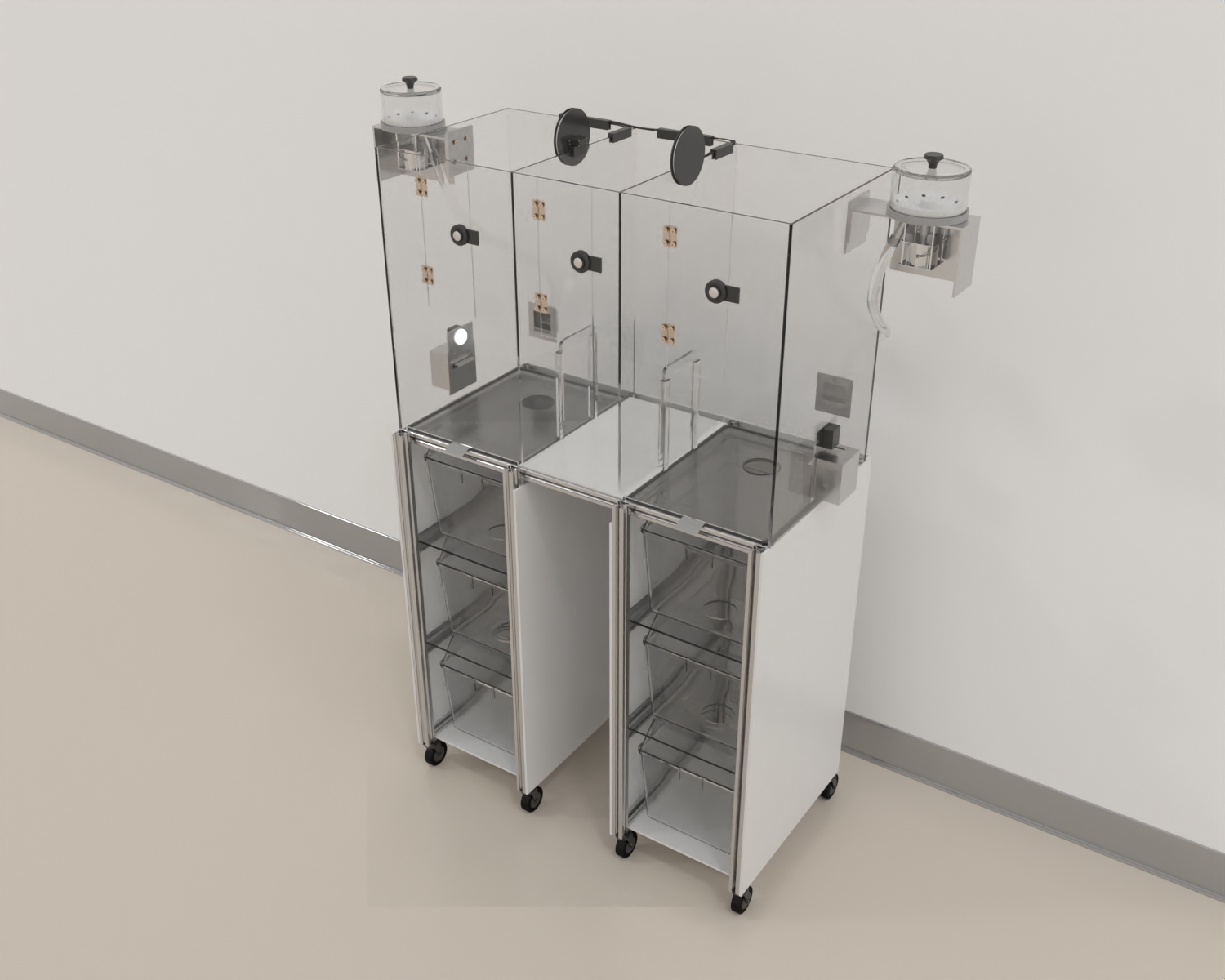
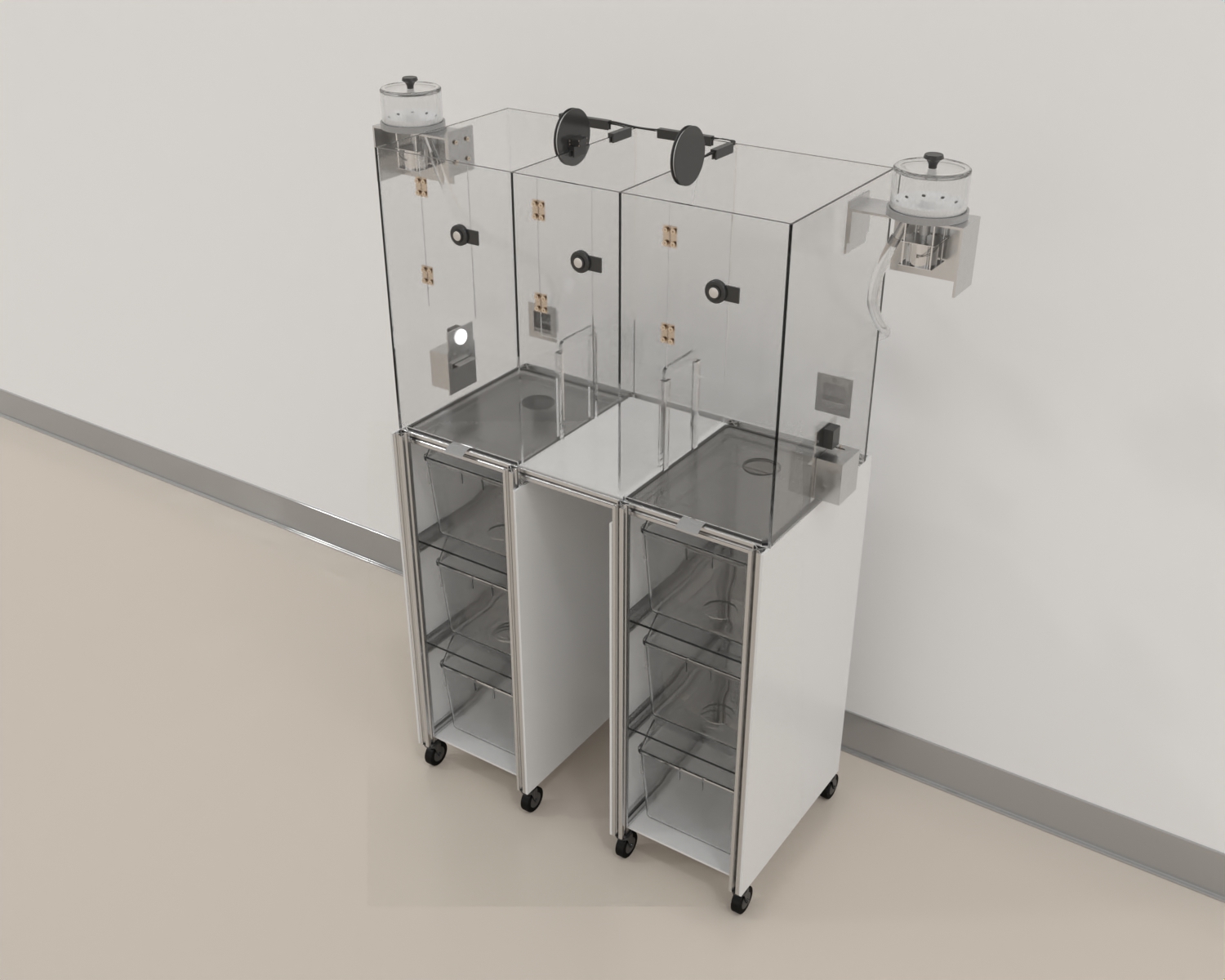
The 3d Vertical Maze is an innovative, modular tool designed to investigate the interplay between social and spatial cognition in rats and mice. Based on the publication "The 3D Vertical Maze: A new model system for studying the interactions between social and spatial cognition". The authors aimed to study realistic social and spatial behaviors beyond the confines of the traditional 2D 3-chamber Sociability or Operant paradigms.
Vertical Maze Overview
Three-Dimensional Design
The maze features a three-chamber platform elevated above vertical columns, allowing controlled presentation of conspecifics at different depths and familiarity levels for studying social and spatial perception.
Multisensory Engagement
Positioning stimulus animals below the arena activates visual, auditory, and olfactory cues, enabling rodents to assess distance, direction, and social identity.
Behavioral Flexibility
Supports both spontaneous exploration and operant conditioning tasks to examine social novelty, spatial discrimination, and learning.
Modular System
The design accommodates automated components — doors, levers, and pellet dispensers — for precise, repeatable experiments across behavioral paradigms.
Vertical Maze
Learn More
Questions?
Request a Quote
Price & Dimensions
Rat Vertical Maze
$4,990
Default:
- Opaque acrylic 3-chamber testing platform (90×50 x 60 cm)
- Two vertical columns (30 ×50 x 90 cm, each)
- Perforated and solid acrylic flooring
Optional:
- Operant set-up: Automated lever, pellet dispenser, and pellet receptacle
- Lights
- Speakers
- Custom manual or automated guillotine door
Mouse
$3,990
Default:
- Opaque acrylic 3-chamber testing platform (63×35 x 48 cm)
- Two vertical columns (21 ×35 x 63 cm, each)
- Perforated and solid acrylic flooring
Optional:
- Operant set-up: Automated lever, pellet dispenser, and pellet receptacle
- Lights
- Speakers
- Custom manual or automated guillotine door
Track rodents with ConductVision
ConductVision is our video-tracking software. Record your sessions on video, and it scores standard rodent tests, such as those listed below.
Examples of tests it scores
To check whether ConductVision scores your protocol in this apparatus, ask in your quote request.
Add ConductVision to your quote
A 5-year license is $3,990 in total.
Results export as CSV files.
Documentation
Introduction
Understanding how rodents navigate complex environments and interpret social cues is central to the study of cognitive neuroscience. Traditional behavioral assays, such as the Operant chamber and 3-chamber Sociability test often examine spatial or social cognition in isolation, limiting insights into how these processes interact in real-world contexts. To address this gap, the Vertical Maze (VM)—a novel, three-dimensional behavioral apparatus was designed to simultaneously assess spatial and social decision-making in rodents.
The VM expands on conventional three-chambered social mazes by adding a vertical dimension, allowing researchers to present social stimuli (i.e., conspecifics) at varying heights and distances. This setup mimics the layered spatial environments rodents naturally encounter and engages multiple sensory modalities including olfaction, vision, and audition. Through both spontaneous exploration and operant conditioning paradigms, the VM enables precise measurements of how animals integrate spatial layout and social information to guide behavior.
By combining multi-level spatial challenges with dynamic social contexts, the VM offers a powerful platform for investigating the neural and behavioral mechanisms underlying complex cognition. It holds particular promise for studying conditions where the integration of spatial and social cues may be disrupted, such as in autism spectrum disorders, schizophrenia, or age-related cognitive decline.
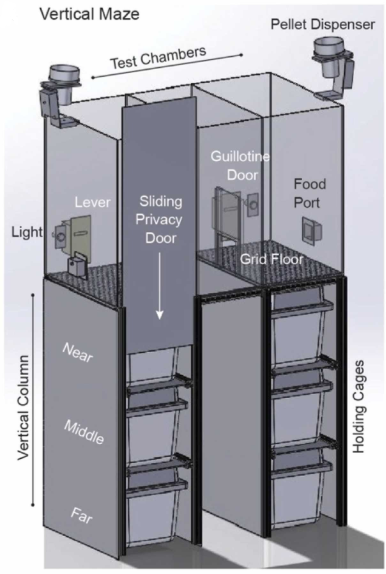
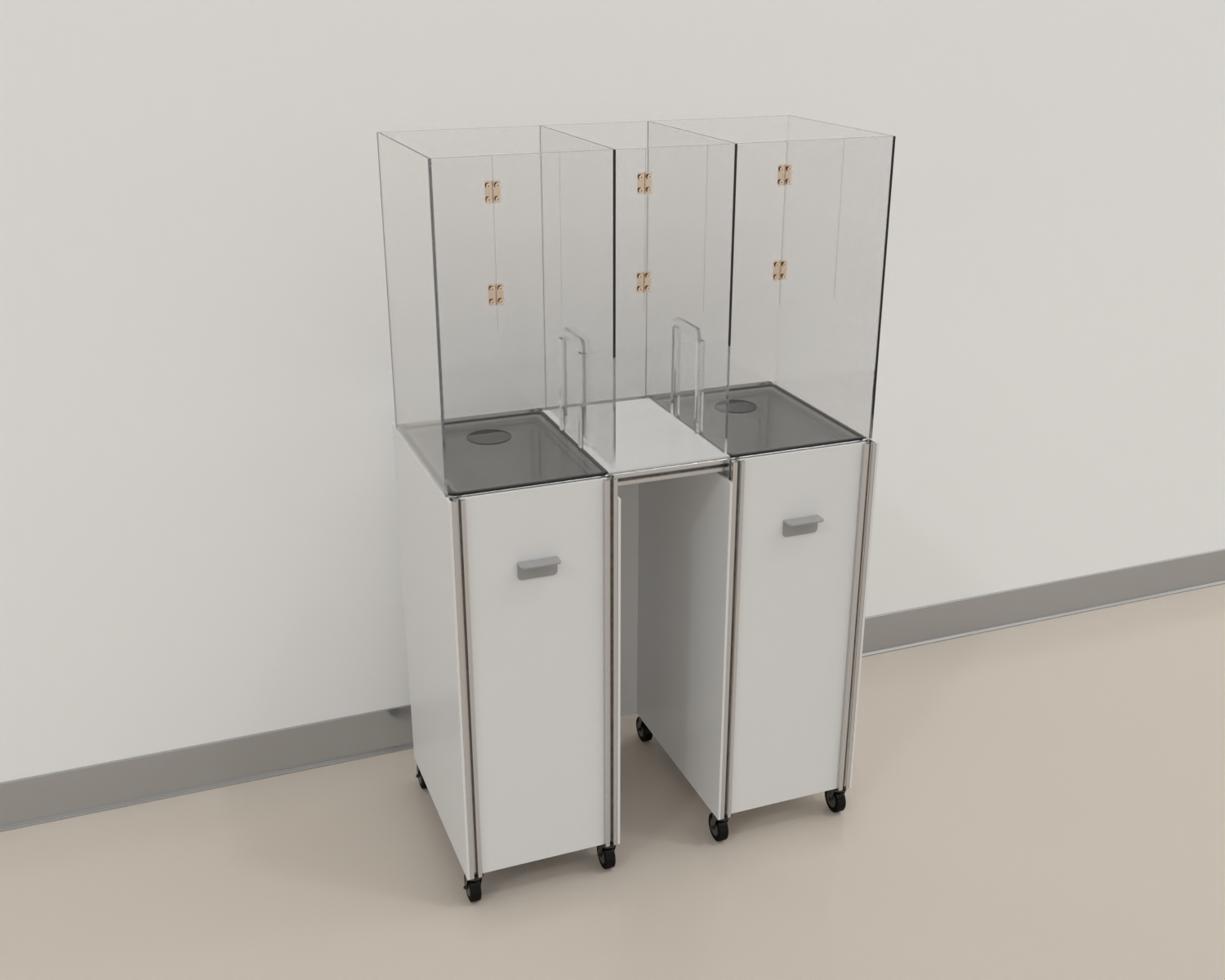
The 3D Vertical maze consists of a 3-chamber testing platform with acrylic walls (90× 50 x 60 cm) positioned above two vertical columns (30 × 50 x 90 cm, each). Opaque acrylic walls ensure that subjects could not see outside of the apparatus (Fig. S1B). The two outer (testing) chambers accommodate interchangeable floors made of wire grid, mesh, or acrylic. Opaque acrylic floors allowed for habituation to the testing chambers only, flooring with access holes allowed for travel between testing chambers and vertical columns, and wire flooring allowed for subject access to conspecifics without physical contact or vertical movement.
Flooring in the middle (start) chamber is composed of opaque acrylic. Optional hardware in each testing chamber can include automated levers, lights, speakers, pellet dispensers and receptacles and an automated guillotine door to control subject access to adjacent chambers.
Two vertical columns positioned below the two outside chambers were designed to accommodate demonstrator holding cages at 29.2 cm, 58.4 cm, and 87.6 cm below the floor of the 3-chamber testing arena. Vertical columns were constructed of T-slotted metal framing.
Apparatus & Equipment
Testing Platform (Three-Chamber Structure)
The main apparatus consists of a transparent acrylic platform with three interconnected chambers (90 × 50 × 60 cm). The central chamber serves as the start zone, flanked by two test chambers designed for controlled social and spatial interactions.
Vertical Columns (Social Interaction Chambers)
Positioned below the test platform, two vertical columns (30 × 50 × 90 cm each) house conspecifics at variable depths (29.2 cm, 58.4 cm, 87.6 cm), allowing precise control of vertical distance for social and perceptual studies.
Interchangeable Floors (Sensory Control)
Each outer chamber includes modular floor panels — wire grid, mesh, or opaque acrylic — for adjusting tactile and visual cues. This design enables flexible experimental conditions ranging from habituation to discrimination learning.
Opaque Central Floor (Habituation Zone)
The middle chamber features an opaque acrylic floor that isolates the animal visually, allowing controlled habituation and preparation before task initiation.
Integrated Hardware (Automation System)
Each chamber can include automated levers, pellet dispensers, lights, and speakers, all managed by a central computer. Guillotine doors enable synchronized transitions between chambers for precise timing control.
Construction & Materials (Durability & Clarity)
Built from T-slotted metal framing and clear or opaque acrylic panels, the maze maintains high optical clarity, durability, and consistency under varied lighting conditions.
Training Protocol
1. Subjects
Both male and female rats or mice were used in all experiments. Animals were divided into two groups based on their experimental role:
-
Experimental subjects: Trained to explore and interact with the maze environment.
-
Stimulus subjects: Placed within lower compartments to serve as social cues.
Apparatus: Vertical Maze (VM) Design
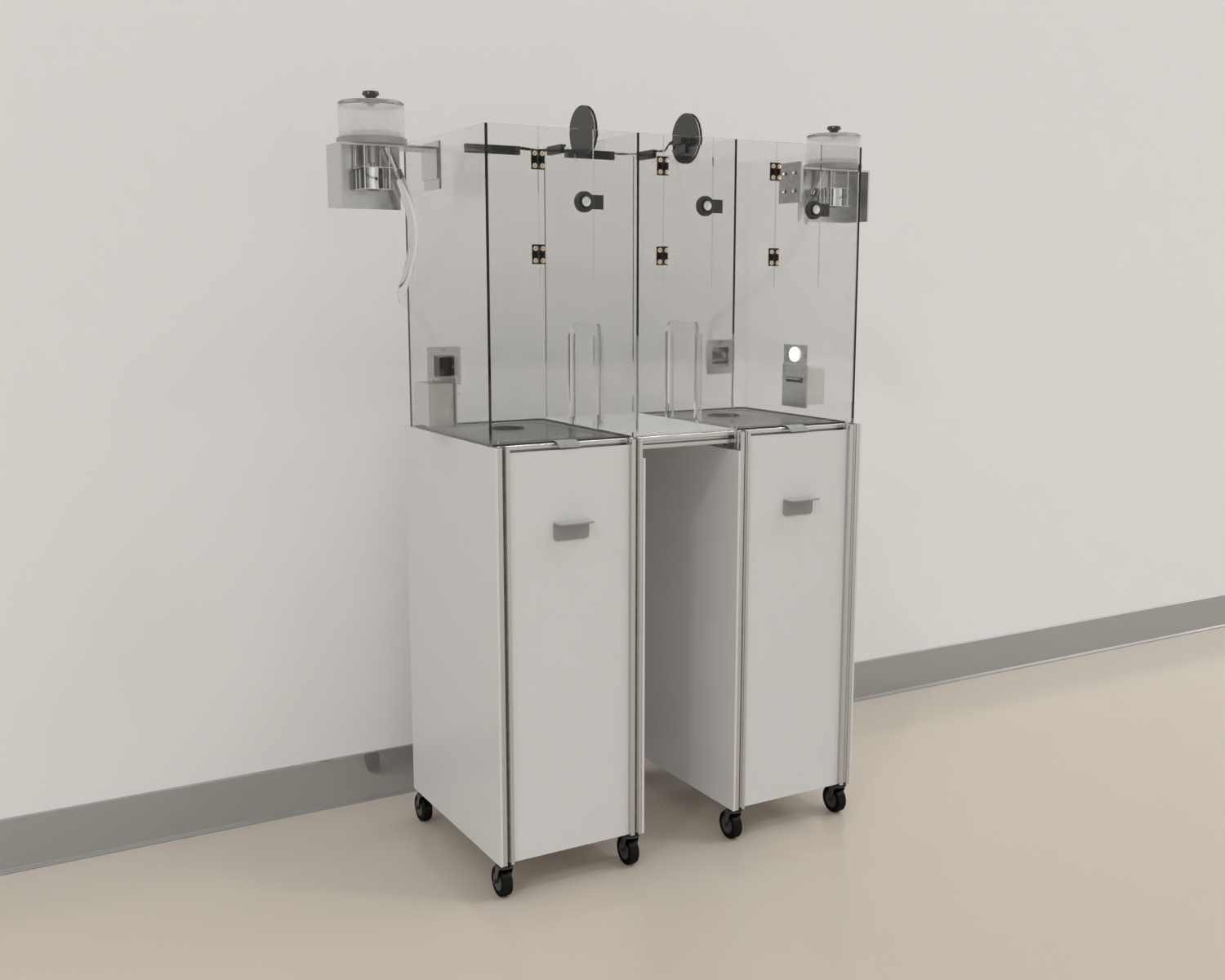
Each vertical column of the apparatus contained a lower compartment that could house a conspecific (stimulus) animal. The upper arena allowed free movement and provided visual access to the compartments below.
Overhead cameras were installed for continuous behavioral tracking and spatial analysis.
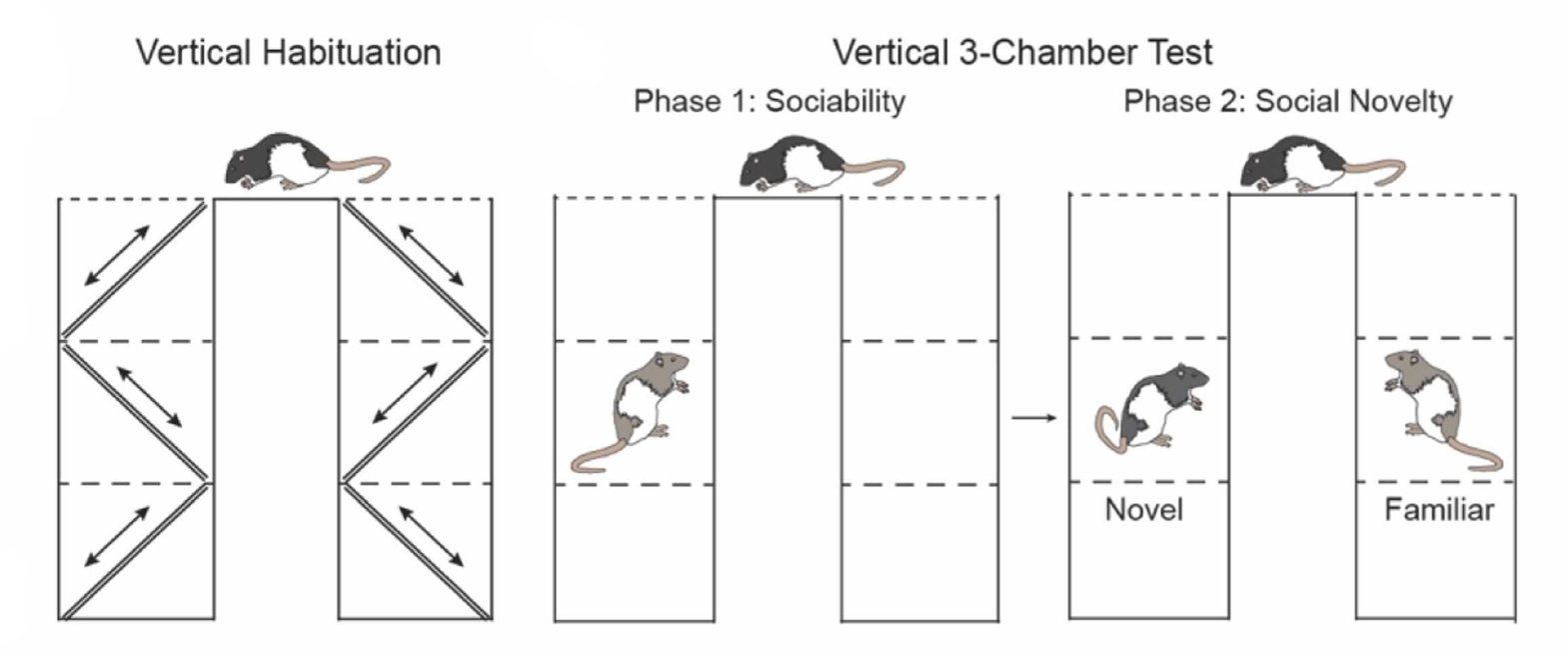
Habituation
Experimental subjects were acclimated to handling and to the Vertical Maze environment over 2–3 sessions.
No stimulus animals were present during this stage to ensure that subjects became familiar with the apparatus and baseline exploration patterns.
Behavioral Paradigms
Two main task types were conducted using the 3D Vertical Maze:
1. Spontaneous Exploration Tests
Subjects were introduced to the maze and allowed to explore freely.
Researchers recorded time spent near various social stimuli (e.g., familiar vs. novel conspecifics; close vs. distant compartments) to assess innate social preferences and spatial bias.
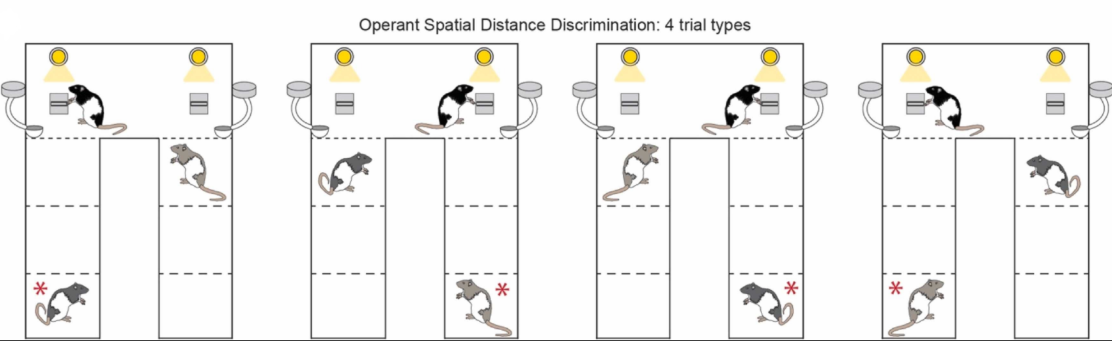
Operant Conditioning Tasks
Subjects were trained to respond to specific social cues or spatial locations to obtain a reward.
These trials assessed learning, memory, and the ability to form and recall spatial–social associations over repeated sessions.
Data Analysis
The 3D Vertical Maze enables precise quantification of how vertical and spatial dimensions influence social and cognitive behavior. The following experimental parameters are typically assessed:
-
Vertical habituation and social preference:
Analysis of discrimination ratios to evaluate sociability and social novelty after repeated vertical exposure. -
Vertical exploration time:
Measurement of total time spent exploring upper versus lower zones, providing insights into motivation and curiosity. -
Spatial distance and social engagement:
Evaluation of how proximity to conspecifics at varying depths affects preference and social interaction. -
Spatial discrimination in operant tasks:
Assessment of accuracy and latency to choice during learned tasks that require recognizing specific vertical or spatial cues.
Literature Review
The 3D Vertical Maze: A new model system for studying the interactions between social and spatial cognition
The 3D Vertical Maze (VM) was utilized to investigate how rats integrate spatial and social information. Adult Long-Evans rats were used as both experimental subjects and social stimuli.
Two types of behavioral assessments were conducted: spontaneous exploration and operant conditioning. In spontaneous exploration trials, experimental rats were allowed to move freely across the upper maze while conspecifics of varying familiarity (familiar vs. unfamiliar) were positioned in different vertical columns. The objective was to measure time spent in proximity to each social stimulus to assess preferences based on both social novelty and spatial distance. In operant conditioning tasks (when used), rats were trained to associate specific zones or stimuli with rewards, testing their ability to learn and apply spatial-social associations. All behavior was recorded via overhead cameras and analyzed using tracking software to quantify metrics such as time spent near stimulus zones and exploration patterns. Data were statistically analyzed to determine the significance of observed behavioral preferences and learning effects.
Key Findings
Social–Spatial Integration
Rats distinguished familiar from unfamiliar conspecifics based on both social identity and vertical position, showing they combine social and spatial information.
Spatial Influence on Social Behavior
Preference for unfamiliar conspecifics varied with height — rats were more responsive to social cues at closer vertical distances.
Multisensory Use
Animals relied on sight, smell, and sound to detect social stimuli, validating the maze’s design for multisensory studies.
Vertical Columns (Social Interaction Chambers)
Positioned below the test platform, two vertical columns (30 × 50 × 90 cm each) house conspecifics at variable depths (29.2 cm, 58.4 cm, 87.6 cm), allowing precise control of vertical distance for social and perceptual studies.
Learning Potential
Rats learned associations between spatial–social configurations and rewards, confirming the maze supports operant conditioning tasks.
References
- Wise TB, Templer VL, Burwell RD. The 3D Vertical Maze: A new model system for studying the interactions between social and spatial cognition. J Neurosci Methods. 2025 Jun;418:110414. doi: 10.1016/j.jneumeth.2025.110414. Epub 2025 Feb 28. PMID: 40024460.