
Plantar Test Hargreave's Apparatus
Description
Thermal withdrawal latency was first described by Hargreaves et al. (1988). It is a widely used test for thermal stimuli responses. In this procedure, a rodent's hind paw is exposed to a beam of radiant heat through a transparent glass surface using the plantar analgesia meter. The latency to withdraw to the heat stimulus is recorded as the time for paw withdrawal in both injured and uninjured hind paws.
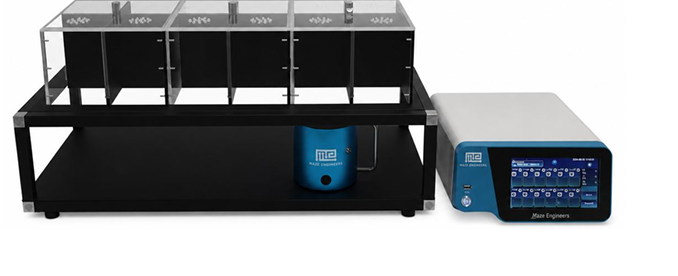
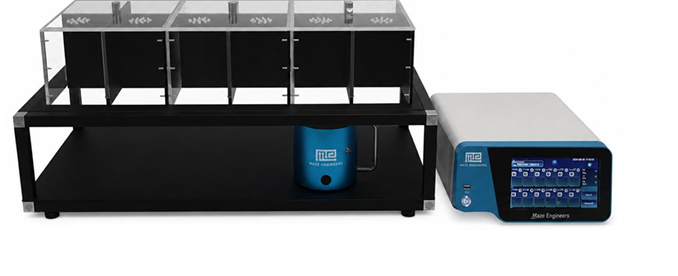
Hargreaves Plantar test apparatus is composed of an emitter/detector vessel controlled by a controller that allows the manipulation of the intensity of heat, a glass panel, and animal enclosures. The size of the enclosures varies depending on the animal being used. The entire apparatus is usually supported at a height on a platform to allow the placement of the emitter/detector vessel.
The infrared (I.R.) heat intensity of the plantar test instrument can be adjusted in increments, usually set at average paw withdrawal latency of approx 10 seconds in rats.
MazeEngineers offers the Plantar Test Hargreave's Apparatus.
Features
- Specifications: Infrared light Power: 0W-100W , adjustment 1W stepwise 5-100% heat intensity adjustment Maximum Illumination time adjustable to the second (0.01-16s)
- Easy Features: 3-6 rodent simultaneous simulation LCD informational display with touch sensitivity Intradevice data storage
- Technical Specifications: Input voltage: AC 220V±5% ; Power: 50W (L) 62 cm x (W) 21 cm x (H) 20.2cm Weight: 3.5kg
- Parameters: Paw withdrawal latency Average reaction time
Price & Dimensions
Plantar Test
$5,990
- Controller Unit
- Touch-screen monitor
- Movable Infrared Source
- Dimensions: (L) 62 cm x (W) 21 cm x (H) 20.2cm
- Focused radiant heat light source (controlled by the controller unit)
- Acrylic animal enclosures (support 1 or 2 or 3 units - each unit containing 4 compartments for mice or 2 compartments for rats)
- Radiometer upon request
Track rodents with ConductVision
ConductVision is our video-tracking software. Record your sessions on video, and it scores standard rodent tests, such as those listed below.
Examples of tests it scores
To check whether ConductVision scores your protocol in this apparatus, ask in your quote request.
Add ConductVision to your quote
A 5-year license is $3,990 in total.
Results export as CSV files.
Documentation
Introduction
Hargreaves Plantar test was first described in the literature by Hargreaves and colleagues in 1988 (Hargreaves et al., 1988). Hargreaves et al. used the test to evaluate cutaneous hyperalgesia resulting from thermal stimulation in rats. The test was designed to assess thermal pain sensations in a specific part of the plantar surfaces of animals. The test has been widely employed in evaluating pain sensitization and responses to pain in subjects recovering from neural injuries and regeneration. The apparatus and assays similar to the Hargreaves Plantar test include the Tail Flick test, Hot-Cold Plate test, and Thermal Gradient test.
The Hargreaves apparatus consists of glass-floored chambers in which the subject is placed, and a radiant or infrared heat stimulus is applied to the center of its plantar surface from underneath. The tests usually last for a maximum of 35 seconds to avoid tissue damage and unnecessary harm to the animals. To ensure that the temperature of the heat stimulus is not affected, urine must be cleaned up during trials. The use of glass flooring helps minimize the heat-sink effects thus allowing more accurate heat stimulus. In comparison to other thermal stimulus assessments, the Hargreaves test does not subject the entire plantar surface to the heating effect. This allows for overcoming issues of heating irrelevant parts of the subject, and that could potentially influence the response of the subject.
Apparatus and Equipment
Hargreaves Plantar test apparatus is composed of an emitter/detector vessel controlled by a controller that allows the manipulation of the intensity of heat, a glass panel, and animal enclosures. The size of the enclosures varies depending on the animal being used. For mice, a compartment of 10 x 10 cm and a height of 15 cm is usually used. The entire apparatus is usually supported at a height on a platform to allow the placement of the emitter/detector vessel.
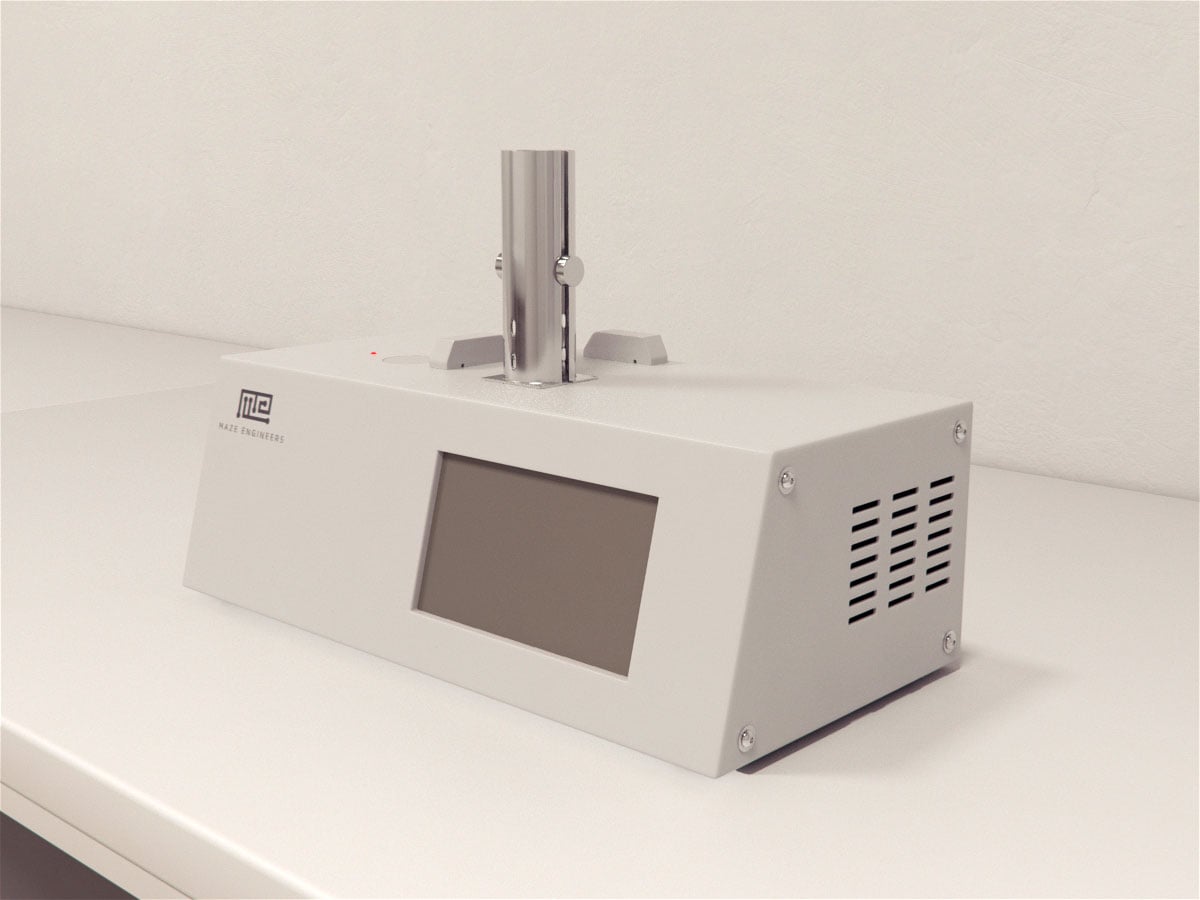
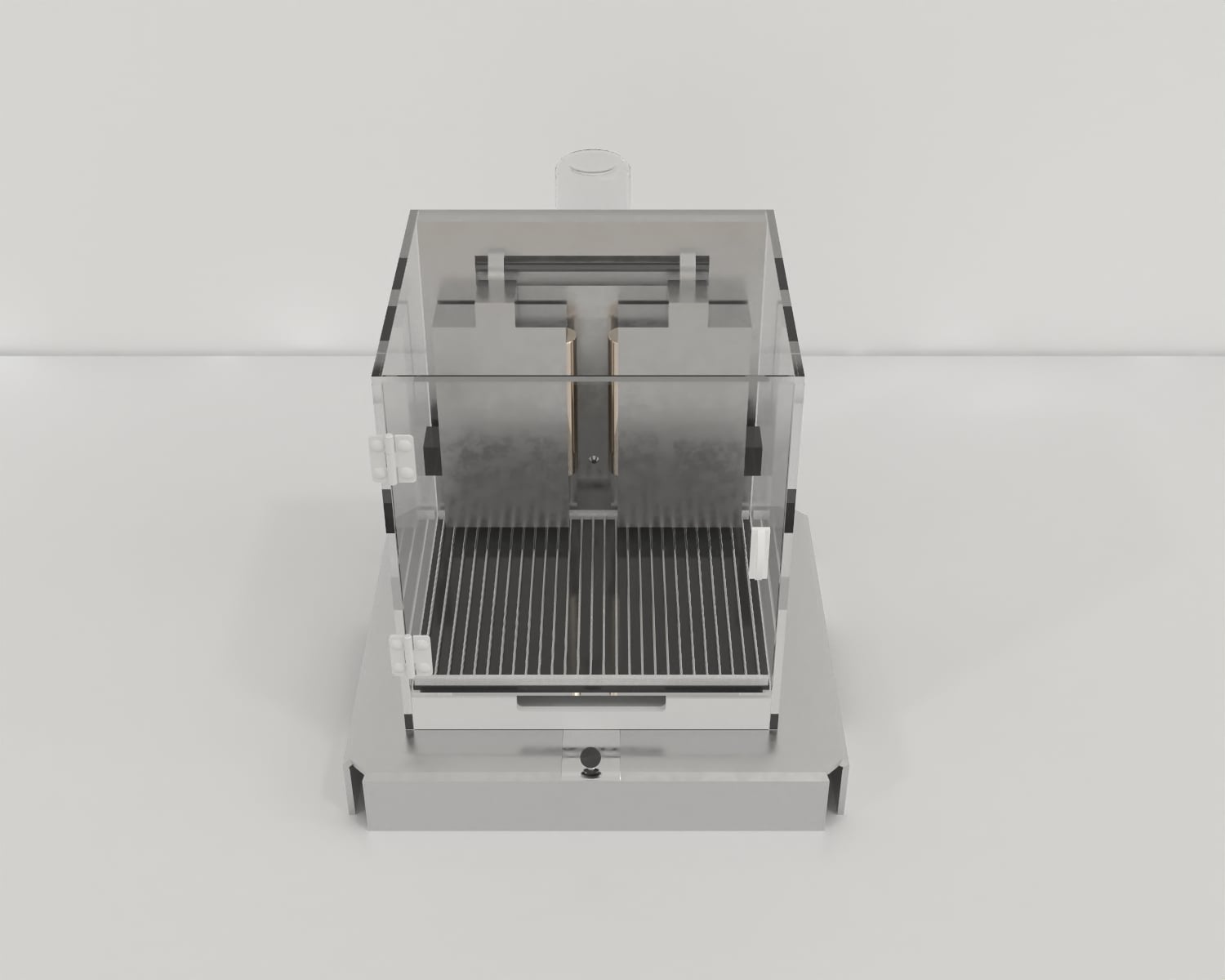
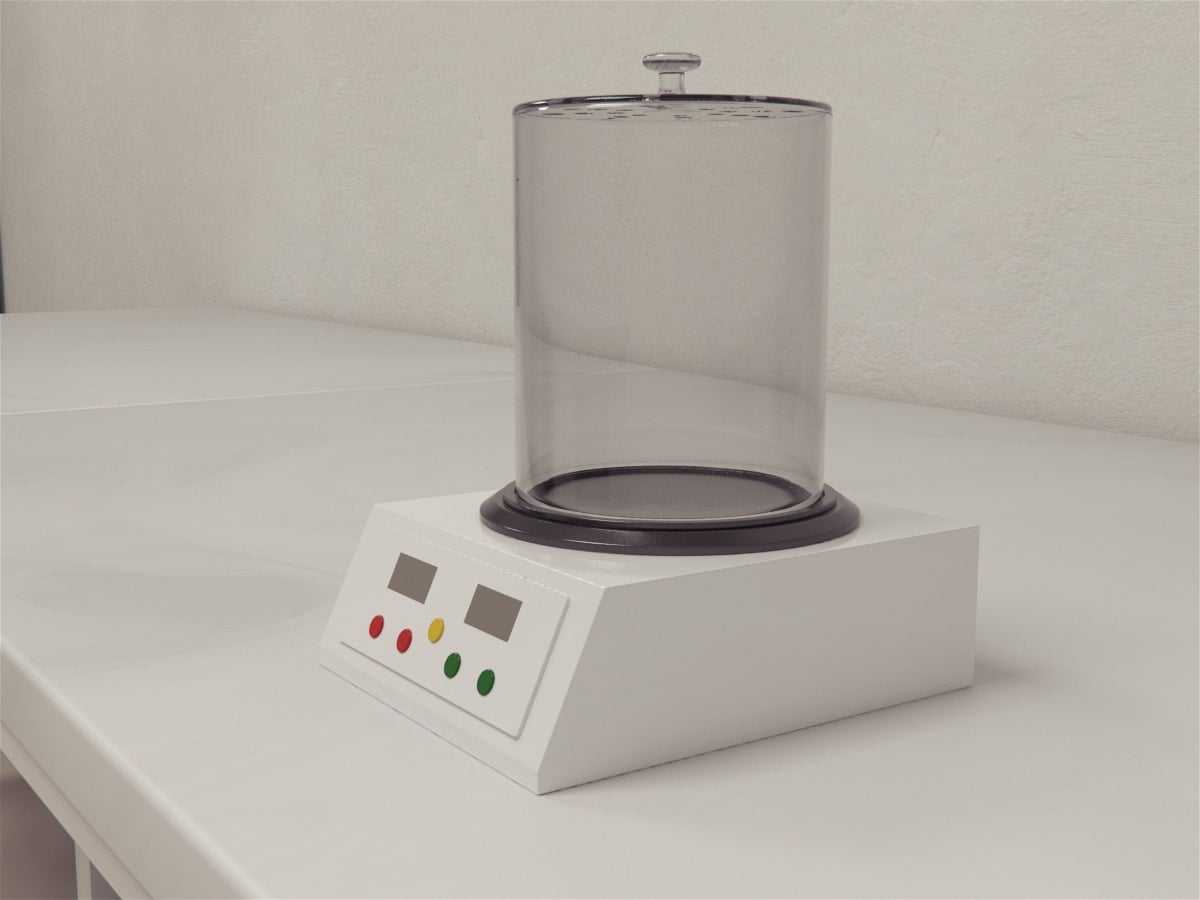
See our similar apparatus
Training Protocol
Before beginning the experiments, the apparatus must be thoroughly cleaned. The performance can be recorded and observed using a tracking and recording system such as ConductVision, the Noldus EthoVision XT or ANY-Maze
Habituation
Gently place the subject within its compartment on the Hargreaves test apparatus. Allow it at least 30 to 60 minutes of exploration time. Repeat this process for at least two days before starting with the Hargreaves test. To help with the habituation process, food or sucrose pellets can be used within the compartments.
Training Trial
Place the subject in its compartment and allow it to acclimate for 15 to 20 minutes. Setting the desired infrared intensity, position the emitter/detector vessel directly under the center of the paw being tested. Start the timer and the infrared light at the same time and observe the subject for pain-elicited behaviors until the cut-off time (usually 20 to 35 seconds) for the experiment has been reached. Repeat trials as necessary with at least a 5-minute inter-trial interval. Licking or shaking of the stimulated paw signs behavior associated with pain.
Determination of the plausible role of Nf1 heterozygosity in pain and itch behaviors
O’Brien et al. (2013) investigated whether Nf1 heterozygosity resulted in increased pain and itch behaviors in mice. For their study, they used seven-to-ten-week-old male Nf1+/− and wild-type littermates. Subjects were placed on a pre-warmed (~30°C) glass plate in their individual chambers. The radiant heat stimulus was applied at an active intensity of 17% maximal for 20 seconds. The next day, subjects received an inflammatory mediator injection, and withdrawal latency was obtained at hourly time points by averaging two measurements per paw during that hour. Data analysis revealed no influence of Nf1 heterozygosity in increasing pain intensity in the subjects.
Data Analysis
The data collected using the Hargreaves test is straightforward. Withdrawal latencies, the time taken to withdraw the paw as a response to heat, and the average reaction time are recorded. It is important to ensure that observed behavior is a reflex behavior and not a voluntary one. In case an ambiguous behavior is observed, repeat the experiment and record the correct withdrawal latency.
Strengths & Limitations
Strength
The Hargreaves test evaluates the thermal nociceptive responses of the subject. As opposed to the Hot plate test which subjects the entire plantar surface of the subject to the heat stimulus, the Hargreaves test uses a directed heat stimulus that tests a particular point on the plantar surface. This allows unilateral response assessments. The apparatus is also simple and straightforward to use. The Hargreaves test uses a compartmentalized area that enables testing multiple subjects at once. The use of glass bottoms for the compartments minimizes the errors arising from heat sink effects. The Hargreaves test is widely used in investigations of neural injuries and regeneration to evaluate pain sensitization or recovery of pain thermal responses
Limitations
While testing in the Hargreaves apparatus, it is important to ensure the apparatus is cleaned before and after trials, and as required during trials since the presence of urine can affect the temperature of the heat stimulus. Care must also be taken to observe and differentiate voluntary behaviors from reflex behaviors. In the case of voluntary behaviors, the experiment should be repeated to obtain accurate results. It is also essential to not exceed the cut-off time to prevent unnecessary damage and harm to the animals used. The test may require longer periods of habituation and acclimation depending on the species and strains as some are known to have an excited exploratory drive. The experiments should also be performed while the subject is awake. It is important to minimize any external stimulus in the test arena to reduce its impact on the subject's performance. The Hargreaves test also does not allow the direct measure of paw withdrawal temperatures. Handling and consistency of the surgical process can also potentially influence paw withdrawal responses.
Summary and Key Points
- Hargreaves test was first described in the literature by Hargreaves and colleagues in 1988.
- Only a specific part of the plantar surface of the animal is subjected to heat stimulus.
- Withdrawal latencies are observed as the time taken to respond to the heat stimulus.
- Different strains and species showcase a range of exploratory drives thus habituation time may be increased or decreased to acclimate the subject to the apparatus.
- Voluntary movements should be clearly distinguished from heat-stimulus-generated reflex movements.