
Blocked Elevated maze
$2,490plus shipping and handling
The Blocked Elevated Maze (BEM) is a type of behavioral test used to assess spatial learning and memory in rodents such as mice and rats. The BEM consists of an elevated platform with multiple blocked and unblocked paths, and the animal is placed in the maze to find its way to a visible escape platform. The test measures the animal's ability to remember the location of the escape platform, and to use that information to navigate the maze efficiently over time. The BEM is used in neuroscientific research to study the neural mechanisms underlying spatial memory and navigation.
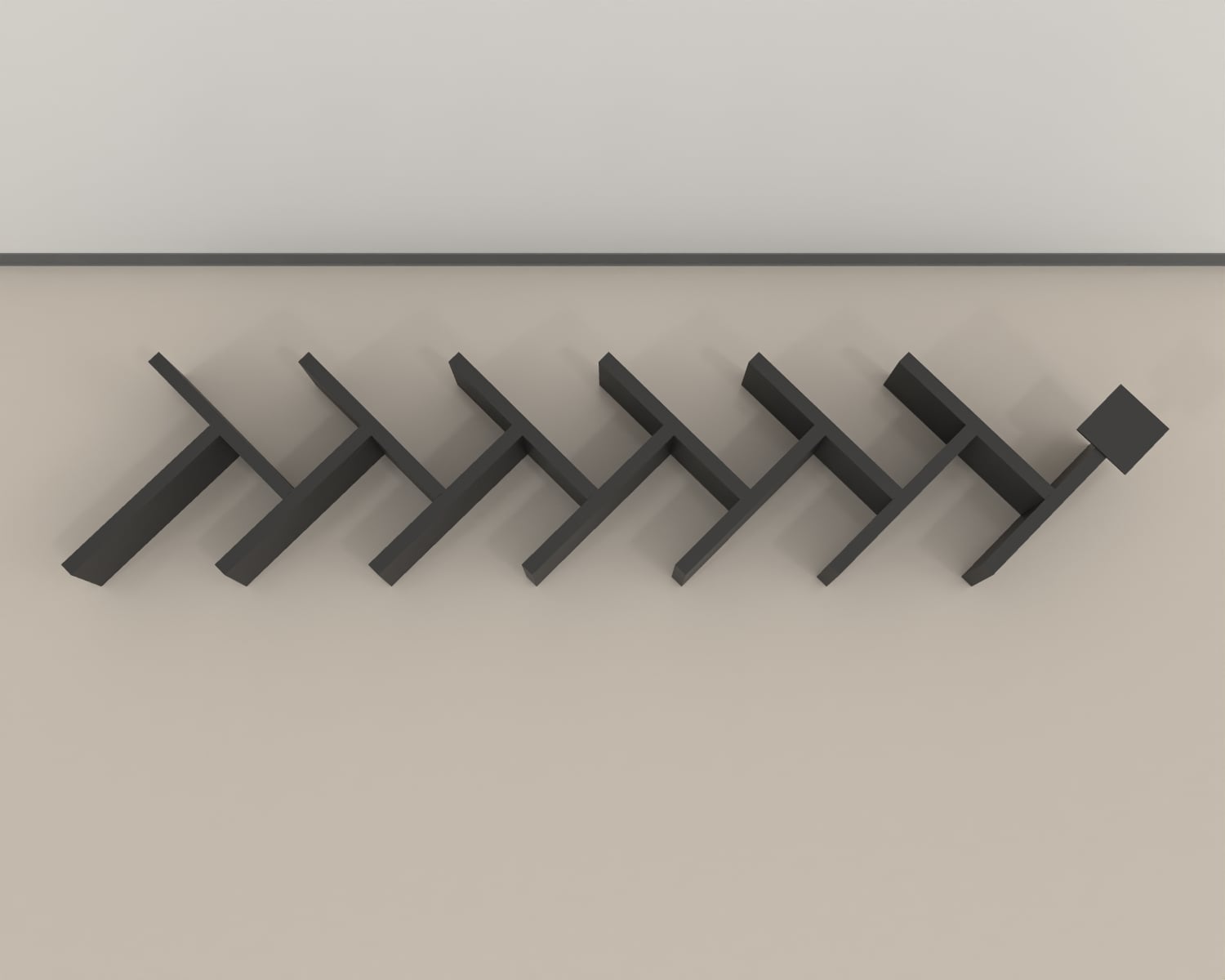
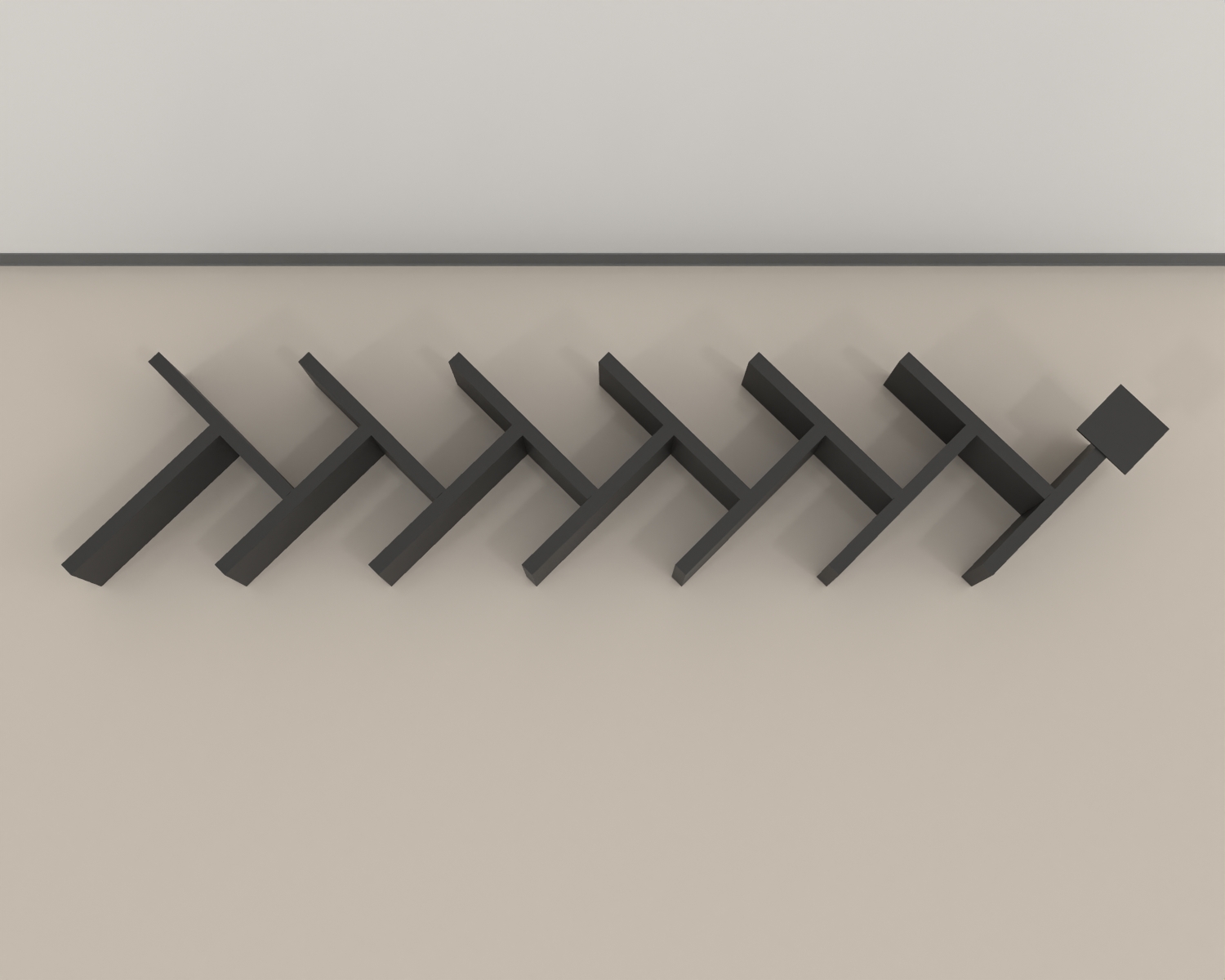
The Blocked Elevated Maze is used to study spatial learning and memory in rodents. It is an adaptation of the standard rodent T-Maze and the Elevated Plus Maze and comprises several elevated blocks arranged in a multiple T zigzag pattern.
The apparatus consists of an elevated pathway constructed of den blocks on a level floor. The blocks are arranged in a zigzag pattern creating 13 units of true pathways and 12 units of blind alleys. A food box is located at the end of the pathway.
MazeEngineers offer the Blocked Elevated Maze. Customizations are available upon request.
Features
Sound (Stimulus Component)
- Sound types: frequency tone (Range 100-20,000Hz frequency; volume 1-100)
- A small speaker
Control Box
- One control box controls the operations of the chamber.
- The controller connects to the PC via a USB (RS-232) cable and communicates with Maze Engineers Conduct Software on the PC.
Visual Cues (Stimulus Component)
- Visual cues are displayed on the screen
- Software program displays visual cues constructed by Conduct Maze software
LCD screen and Computer
- The user will provide an LCD screen and computer
- The LCD screen is used for software program display and visual cue display
Shocker and Mesh Floor (Stimulus Component)
- Current level 0.1-4.0 mA step 0.1
- Electric shocks: (DC: 5V (0.12 mA), 50-ms duration, 10 Hz, AC: 2.5V) are delivered via steel mesh plates placed on both sides of the three arms
- Voltage, current level, and duration are configurable
- Mesh grids are attached to all walls (all three arms for consistency)
Estimated Delivery
- Estimated delivery time is about 6-8 weeks
Software
- User has video tracking software that provides protocol setup and controls the experiment
- The user’s video tracking software keeps tracking of the fish position and sends commands to Maze Engineers’ Conduct Software in real-time. MazeEngineers Conduct software accepts the commands and controls the visual cue display, tone cue, and shocks accordingly.
- MazeEngineers Conduct software dynamically draws visual cues based on the arm partitioned regions.
- Example "No shock": when the experiment starts:
- The video tracking software sends a command to play a tone (700Hz, 0.5s, 63dB)
- The video tracking software sends a command to display a certain visual cue on the screen
- Load initial visual cue
- Maintain the cue until fish reaches the goal region or 30s passed (video tracking sends a command to Conduct Software)
- When in the goal region, change the visual cue
- Repeat trial of the above
- Example "Shock": when the experiment starts:
- The video tracking software sends a command to play a tone (700Hz, 0.5s, 63dB)
- The video tracking software sends a command to display a certain visual cue on the screen
- Load initial visual cue
- Maintain the cue until fish reaches the goal region or 30s passed (video tracking sends a command to ME Conduct software)
- When in the goal region, change the visual cue
- Deliver shock for a certain duration (~500ms)
- if the fish did not reach the goal region within 15s, all regions within the tank receive the
continuous electric shock - Repeat trial of the above
Price & Dimensions
Blocked Elevated Maze
$2,490plus shipping and handling
- Elevated pathway constructed on a level floor
- Blocks dimensions: 4.50cm x 30cm x 60.90cm (width x height x length)
- Zigzag pattern: 13 units of true pathways and 12 units of blind alleys
- Food box located at the end of the pathway
Track rodents with ConductVision
ConductVision is our video-tracking software. Record your sessions on video, and it scores standard rodent tests, such as those listed below.
Examples of tests it scores
To check whether ConductVision scores your protocol in this apparatus, ask in your quote request.
Add ConductVision to your quote
A 5-year license is $3,990 in total.
Results export as CSV files.
Documentation
Introduction
The Blocked Elevated Maze is used to study spatial learning and memory in rodents. It is an adaptation of the standard rodent T-Maze and the Elevated Plus Maze and comprises several elevated blocks arranged in a multiple T zigzag pattern. A food box is located at the end of the maze, and the subject is required to make a simple left or right alternation of direction in each block to reach the end. Therefore, rodents must make multiple correct choices within a single trial, which challenges their spatial learning and memory greater than simple two-choice mazes.
The Blocked Elevated Maze's elevated pathway is constructed of multiple den blocks. These blocks can be arranged according to experiment needs, allowing rodents to be tested using any maze pattern. The standard T zigzag T configuration creates 13 units of true pathways and 12 units of blind alleys. On the other hand, a double alternation configuration creates 17 sections of true pathways and 16 blind alleys, creating a higher number of total entrances into true sections and greater space for exploration. The ability to remove and rearrange the blocks is also advantageous for transportation and storage purposes. Furthermore, an elevated Y-Maze or T-Maze can be constructed using three blocks of the Blocked Elevated Maze.
Apparatus and Equipment
The apparatus consists of an elevated pathway constructed of den blocks on a level floor. The blocks measure 1 34 inches in width, 12 inches in height, and 24 inches in length. The blocks are arranged in a zigzag pattern creating 13 units of true pathways and 12 units of blind alleys. A food box is located at the end of the pathway.
Training Protocol
Blocked Elevated Maze Task
Place the subject on Block 1 of the apparatus. Allow it to explore the maze and reach the food box. Remove the subject from the apparatus as soon as it arrives at the food box. If the subject is inactive for more than three minutes during exploration, remove it from the maze.
Literature Review
The investigation of initial rodent behavior on the Blocked Elevated Maze
Dennis and Henneman (1932) investigated initial rodent behavior on the Blocked Elevated Maze. Fifty-nine regular white rats were used in the study. Individual rats were required to explore the maze and reach the food box at the end. The subjects were removed from the maze if they were inactive for three minutes during exploration. The experimenters observed the subjects' behavior by standing behind a screen at a certain distance from the apparatus. The results indicated that twenty-one rats reached the food box within three minutes. Eighteen went beyond Block 4 but did not reach the food box and spent an average of 6.3 minutes on the maze. Fifteen rats went beyond the first unit of the true pathway but did not go beyond Block 4 and spent an average of 3.5 minutes on the maze. Lastly, five rats did not leave Block 1 and spent an average of 5 minutes on the maze.
The investigation of negative adaptation to maze exploration in rodents
Dennis and Sollenberger (1934) investigated negative adaptation to maze exploration in rodents using the Block Elevated Maze. Forty-four untrained Wistar albino rats six to twelve weeks old were used in the study. Two experiments were conducted depending on the maze configuration. In the first experiment, the standard configuration of the Blocked Elevated Maze was utilized. However, in the second experiment, the maze was modified such that there were sixteen dead ends and seventeen sections of true pathway. The second experiment was conducted on the same subjects fourteen days after the first experiment. The subjects were deprived of food for twenty-four hours before the experiments.
In each experiment, the subject was allowed to explore the maze for five minutes. The kind of entrances the subjects made when entering each block of the maze was recorded. The first entrance was a full-body entrance classified as the subject placing all four feet upon a block and performing a complete turn before emerging from the alley. The second entrance was a partial entrance classified as the subject only placing its front feet on a block and retreating by pivoting on the block on which its hind feet remained.
The results from the first experiment indicated that the forty-four subjects made 354 full-body entrances and 6 partial entrances into the arms of the apparatus during the five minutes. The number of alley entrances peaked in the first minute and steadily fell over the course of the following five minutes. There were 100, 80, 69, 64, and 41 entrances per minute, respectively. Activity in the fifth minute was less than half that of the first minute. The results from the second experiment indicated that there were 1,038 full-body entrances in total. This was three times the activity the same rats made on a single unit of the same maze two weeks prior. The increase in activity was potentially due to the greater space for exploration. The total number of complete body entrances throughout the minutes was 153, 205, 254, 239, and 187. Activity peaked in the third minute before declining. During the fifth minute, activity is only 74% of what it was in the third minute. Compared to experiment 1, this drop is not as significant. Overall results indicated that the rats tend to steer clear of previously traveled paths during the initial exploration of a maze and also tend to cover less area each minute as they travel on.
Data Analysis
The following parameters can be observed using the Blocked Elevated Maze:
- Number of turns to a true pathway
- Number of turns to a blind alley
- Number of subjects that reached the food box
- Number of subjects that did not reach the food box
- Number of full-body entrances on each maze block
- Number of partial body entrances on each maze block
Strengths and Limitations
The Blocked Elevated Maze challenges rodents' spatial memory and learning by having several decision points within the maze. The maze blocks are removable and can be rearranged, allowing rodents to be tested using several maze patterns. Moreover, the units can be rearranged for sensory control tests and for easy transportation and storage of the maze. An elevated T-Maze and Y-Maze can also be constructed using three blocks from the Blocked Elevated Maze. The elevated nature allows rodents' behavior to be more visible during exploration. Furthermore, it is easier to keep the maze clean. Rodents can also be presented with a completely unused pathway by turning the blocks upside down. Therefore, the blocks can be cleaned or washed after every two trials instead of a single trial.
The Blocked Elevated Maze requires the experimenter to be in the room at all times since rodents can occasionally fall from the maze during trials. External visual factors can only be eliminated by blinding the rodents or conducting the experiment in the dark. Since the maze pathway is long, rodents require substantial motivation to explore the entire maze and reach the food box. This motivation may be achieved by depriving the subjects of food before conducting trials.
Summary
- The Blocked Elevated Maze is used to study spatial learning and memory in rodents.
- It comprises several elevated blocks arranged in a multiple T zigzag pattern with a food box located at its end.
- Rodents must make multiple correct choices within a single trial using the Blocked Elevated Maze, which challenges their spatial learning and memory greater than simple two-choice mazes.
- The blocks of the maze can be rearranged according to experiment needs, allowing rodents to be tested using any maze pattern. It also allows for easy transportation and storage.
- Rodents can be presented with a completely unused pathway by turning the blocks upside down. Therefore, the blocks can be cleaned or washed after every two trials instead of a single trial.
- Rodents require substantial motivation to explore the entire maze and reach the food box since the maze pathway is long.
References
- Dennis, W., & Henneman, R. H. (1932). The Non-Random Character of Initial Maze Behavior. The Pedagogical Seminary and Journal of Genetic Psychology, 40(2), 396–405. doi:10.1080/08856559.1932.105324
- Dennis, W. (1931). A block elevated maze for rats. Journal of Comparative Psychology, 12(4), 429–432. doi:10.1037/h0071106
- Dennis, W., & Sollenberger, R. T. (1934). Negative adaptation in the maze exploration of albino rats. Journal of Comparative Psychology, 18(2), 197–206. doi:10.1037/h0073802