Complex Behaviors
Animal Models of Executive Function
July 5, 2021
The brain acts as a “black box” where sensory inputs are processed and transformed into action to survive and succeed. As the organism becomes more complex,…
Modeling Intelligence in Rodents
July 2, 2021
Nicola Tesla, Marie Curie, Albert Einstein, and Stephan Hawking are names associated with high intelligence. People want to understand this fascinating trait…
Modeling Chronic Stress
June 14, 2021
In order to survive, our bodies need to constantly adapt to environmental challenges. This process of regulation is called homeostasis[1] and describes…
Rodent Models of Empathy Disorders
May 31, 2021
Empathy is the capability to not only recognize and understand another individual’s emotional state and experience, but to also share these feelings and…




In this section, we explore the different models used for recreating complex behaviors. These complex behaviors are differentiated by the presence of a key cognitive component. Although all models in animal research are complex in their own regard, here we cover particularly challenging topics such as creativity, genius, music, and more.
For related content, see:
- Neurological Disease Models: Browse through the various rodent models which are specifically used to model neurological diseases. Featured topics range from seizures to PTSD to depression.
- Non-Neurological Disease Models: Non-neurological diseases can also affect behaviors. Here, we highlight the many non-neurological disease models used in neuroscience research.
- Animal Models: See how different types of animals, like sheep and pigs, are used in animal research and what they can teach us about behavioral neuroscience.
- Mouse Ethogram: A comprehensive resource that lists detailed information profiling all known mouse behaviors, including information on pharmaceutical studies, disease models, and different mouse strains that display the behavior in focus.
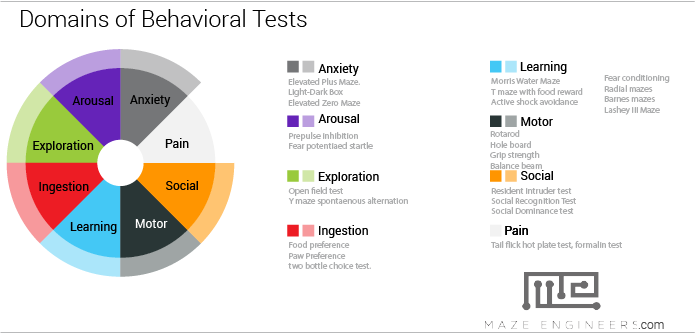
Domains of Behavioral Tests
January 3, 2014
Hey Folks! We often hear from scientists and researchers to be that they have a hard time differentiating the many types of behavioral tests! We made this…