
Catalepsy Bar Test
From$4,995plus shipping and handling
2 models
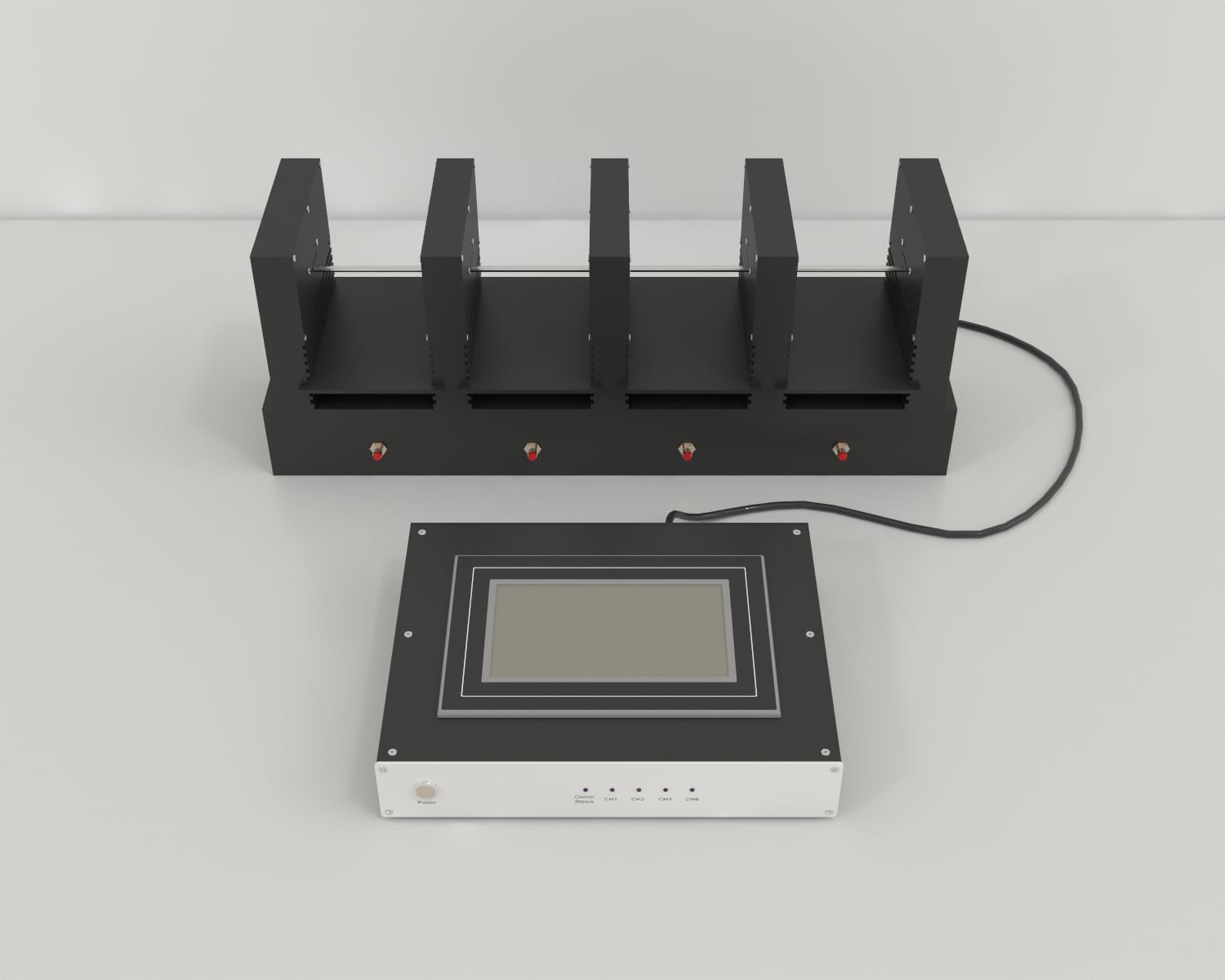
The Catalepsy Bar Test is an alternative to the Rotarod and was developed to test motor coordination and motor impairments (Deacon., 2013; Hoffman et al., 1995; Luciani et al., 202). The Catalepsy Bar Test involves placing the forepaws of a rodent subject onto a bar and timing how long it takes for the subject to remove one or both paws from the bar. The automated Maze Engineers Catalepsy Bar test has 4 lanes for the simultaneous study of 4 subjects simultaneously with adjustable bar height to ensure perfect placement for your subjects. Sensors to detect when an animal removes its paws from the bar and included software logs the time at which this occurs.
MazeEngineers offers the Catalepsy Bar Test. Customizations are available upon request.
Other apparatuses used in assessing rodent motor function include the Grip Strength test, the Balance Beam, the Parallel Bars, the Geotaxis Test, the Static Rods Test, the Gait Test, the Parallel Rod test, and the Pole test. See our activity range here.
Features
Hardware
- The Catalepsy Bar Test has 4 lanes with a lane width of 10 cm for mice and 15cm for rats
- Metal bar is used with a bar diameter of 0.7 cm
- The distance of the bar above the floor is adjustable between 3-8cm (6cm on average)
- Separators are made of black acrylic of thickness
- Four manual start buttons (not used)
- Wire connector on the back to the control box
Control Box
- Touch screen - capacitive HD LCD screen with high response speed and easy to operate
- Touch screen - dimension 16 x 9 cm
- Front panel – power switch, light indicators
- Back panel – communication cable to the Bar, USB drive to expert data and power cord
Sensor Array
- Each lane has one pair of sensor arrays right above the bar to detect the animal on and off the bar
- The timer to record the start and stop time is per lane
Cable Connection
- Single wire to connect between the control box and the bar
- Connect the cable before power on
Software
- Main Screen: The main screen appears as below after power on
- Data Screen: The data screen shows the datasets of the complete trials.
- Settings Screen: This allows the user to set language preference, screen sound, and brightness.
Price & Dimensions
Catalepsy Bar Test for mice
$4,995plus shipping and handling
- 4 lanes
- Lane width: 6 cm
- Bar diameter 0.7 cm
- The distance of the bar above the floor is adjustable between 3-8cm (6cm on average)
- Separators are made of black acrylic of thickness
- Four manual start buttons (not used)
- Wire connector on the back to the control box
Catalepsy Bar Test for rat
$5,295plus shipping and handling
- 4 lanes
- Lane width: 10 cm
- Bar diameter 0.9 cm
- The distance of the bar above the floor is adjustable between 3-8cm (6cm on average)
- Separators are made of black acrylic of thickness
- Four manual start buttons (not used)
- Wire connector on the back to the control box
Track rodents with ConductVision
ConductVision is our video-tracking software. Record your sessions on video, and it scores standard rodent tests, such as those listed below.
Examples of tests it scores
To check whether ConductVision scores your protocol in this apparatus, ask in your quote request.
Add ConductVision to your quote
A 5-year license is $3,990 in total.
Results export as CSV files.
Documentation
Introduction
The Automated Avoidance Zebrafish Y-maze is an operant conditioning assay used to study avoidance behaviors in zebrafish when presented with an aversive stimulus. It is an automated version of the Zebrafish Y-maze Avoidance apparatus. The conventional Zebrafish Y-maze Avoidance only utilizes visual cues displayed through an LCD screen under the maze for studying avoidance behaviors. However, the Automated maze also provides additional stimuli, including speakers for providing auditory cues and aversive stimuli administered in the form of electric shocks. The shocks are administered through steel mesh plates equipped on opposite walls of each maze arm. Additionally, it includes video tracking software that sets up the protocol and controls the duration of each stimulus and when it will be presented. Therefore, the Automated Avoidance Zebrafish Y-maze eliminates the need to control multiple stimuli, which reduces human error and also helps save time.
The Automated Avoidance Zebrafish Y-Maze is a learning task that helps study zebrafish behaviors. During the avoidance task, the subjects must learn to associate the presence of a colored cue with an electric shock. All regions of the floor are colored red by the LCD screen except one region defined as the "goal region", which remains gray. The subject is challenged to swim to the goal region within a required time limit (usually 15 seconds) or an electric shock is administered throughout the maze (except the goal arm) until the trial ends. Although the auditory cue is presented at the start of each trial to signify its start, it can also be used as a conditioned stimulus in addition to or apart from the visual cues.
A major benefit of using the Automated Avoidance Zebrafish Y-maze is that it can easily be modified or adapted for various experimental protocols. Thus, reducing the need for having several different behavioral apparatuses to examine different behavioral parameters. For example, the maze can be used for visual and auditory discrimination paradigms by placing different stimuli in each maze arm. Furthermore, studying zebrafish behaviors using this maze can be used as a model to interpret human behavioral phenotypes in behavioral neuroscience. Moreover, it can also be used to understand the neural basis of behaviors, neuropsychiatric disorders, and how drugs can influence the brain (Marcon, Benvenutti, Gallas-Lopes, Herrmann, & Piato, 2021).
Apparatus and Equipment
The Automated Avoidance Zebrafish Y-maze consists of an acrylic Y-maze with three maze arms and includes video tracking software. The maze measures 15 cm in length, 7 cm in width, and 10 cm in height. A video camera is placed 60 cm above the maze, which records the subject's behavior. The video tracking software sets up the protocol and controls the experiment.
The maze provides several conditioning stimuli. A small speaker connected to the maze provides auditory stimuli with a frequency tone ranging between 100- 20,000 Hz and a volume between 1-100. Visual stimuli are displayed on an LCD screen placed below the maze and controlled by a software program. All walls of the maze contain mesh grids, and the three maze arms are equipped with steel mesh plates on both sides. The plates deliver electric shocks of DC: 5V (0.12 mA), 50-ms duration, 10 Hz, AC: 2.5V. The voltage, current, and duration of the shocks are configurable.
The video tracking software controls all stimuli, such as sending commands to play the sound, displaying the visual cue, and administering the electric shocks, which are all configurable. The apparatus also contains a control box, which connects to a PC that controls all the operations.
Training Protocol
Separate the subjects by placing them individually in 1-liter tanks a day before the experiment.
- Habituation
On the day of the experiment, place a subject in the Automated Avoidance Zebrafish Y-Maze. Cover the maze with a transparent lid to prevent escape. Allow the floor of the entire tank to remain colored gray (53 lx). Monitor the subject's movements with the video tracking software. Conduct habituation for 10 minutes before starting the trials.
The habituation period is necessary to prevent the subject from experiencing stress of being transferred from its home tank to the apparatus and to reduce fear of being in a novel environment.
- Automated Avoidance Zebrafish Y-maze Training
Conduct twenty initial 'no shock' trials followed by one hundred 'shock' trials during training. Place a subject in the maze. Present an auditory cue (700 Hz, 0.5 s, 63 dB) at the start of the trial. Select one arm end as the goal region where the subject is not present or last visited. Change the color of all regions except the goal region to red (27 lx) using the LCD screen. Allow the color to remain red until the subject reaches the goal region until 30 seconds have elapsed (during shock trials). If the subject reaches the goal region, provide an auditory cue (1400 Hz, 0.5 s, 63 dB). If the subject does not reach the goal region in the 'shock' trials within 15 seconds, administer a continuous electric shock in all regions of the maze except the goal arm until the trial ends.
Allow the floor of the apparatus to be colored gray during inter-trial intervals comprising 30 seconds. The inter-trial interval allows the subject to recover from the aversive experience.
Literature Review
Evaluation of associative learning in zebrafish using an Automated Avoidance Y-Maze
Aoki, Tsuboi, and Okamoto (2015) developed the Automated Avoidance Y-maze to study associative learning in zebrafish (Danio rerio) and to increase the experiment's productivity. Wild-type zebrafish of 6-12 months old were used. The maze was placed in a soundproof box and on top of a 24.1 inches LCD screen. The subjects' behaviors were recorded with a video camera connected to a computer. The video software controlled the tones via a speaker and presented the visual cues on the screen. Electric shocks were delivered by the steel mesh plates in the maze arms. In addition, the screen contained small fans that kept the water temperature within 29 - 30°C and dissipated heat generated by the screen.
Twenty initial 'no shock' trials were conducted, followed by one hundred 'shock' trials. During training, the goal region was colored red by the LCD screen, and the subject was required to reach the goal within a required time limit (30 seconds for 'no shock' trials and 15 seconds for 'shock' trials). Electric shocks were given in the entire maze except for the goal arm if the subject didn't reach the goal region during 'shock' trials. It was observed that the subjects displayed active locomotion during all trials. The results indicated that the subjects reached the goal region within 15 seconds in all 'no shock' trials. However, a tendency to visit the goal arm first was not present. In the 'shock' trials, the subjects reached the goal region with a 100% correct rate by trials 41-43. However, a decrease in success in the goal region was observed between trials 44-61 despite the subjects repeatedly receiving electric shocks. The subjects rushed to the goal region only after the electric shock was turned on. During trials 62 – 120, the success rate increased, and the subjects directly swam to the goal region. Overall results indicated that the subjects displayed associative learning of the electric shocks with the red color cues and learned to display avoidance behaviors with the red color cues.
Data Analysis
The following parameters can be observed using the Automated Avoidance Zebrafish Y-Maze:
- The arm the subject visited first
- Time taken to reach the goal region
- The number of times the subject reached the goal region within the required time limit
- The number of times the subject did not reach the goal region within the required time limit
- Trial duration
Strengths and Limitations
Strengths
The Automated Avoidance Zebrafish Y-maze helps save time from manually performing the experiment. It eliminates the need to monitor the fish movement, turn on the visual cues, present the auditory cues, turn on the electrical shock, and turn off all stimuli. The video tracking software controls the experiment and tracks the subject's locomotion throughout the experiment. Moreover, the automated maze also eliminates human errors. The experimenter does not have to be in the experimental room when conducting the experiment. On the other hand, manually performing the experiment requires a human observer to be present in the experimental room, which can influence learning success. The maze includes several different stimuli (visual, auditory, and aversive), which are all configurable. They can also be adapted for other experimental protocols. Having more than one apparatus also allows multiple fish to be trained simultaneously.
Limitations
It is important to consider the size of the fish that can be utilized in the maze, or the protocol should be adapted according to the size of the fish. For example, smaller fish may not be able to reach the goal region within only a few seconds. Moreover, bigger fish may reach the goal region within a few seconds without any effort. Therefore, the size of the fish and even the age and strain of the fish can influence the results. The LCD screen placed below the tank can heat the water. Therefore, it is important to monitor the water temperature and place cooling fans to prevent high temperatures, which can cause stress to the subjects. The visual cues should also not be too bright since they may affect the visual system of the subjects. Utilizing electric shocks repeatedly can significantly affect the subject mentally and physically; therefore, a suitable number of trials should be conducted per day.
Summary
- The Automated Avoidance Zebrafish Y-Maze is an operant conditioning assay used to study avoidance behaviors in zebrafish when presented with an aversive stimulus.
- It consists of a Y-Maze with an LCD screen placed below the maze that displays visual cues throughout all regions of the maze.
- It also includes speakers for providing auditory cues and mesh plates equipped on opposites sides of each maze wall that administers electric shocks throughout the maze.
- A video tracking software sets up the protocol and controls the experiment. It can control the duration of each stimulus and when it will be presented.
- The Automated Avoidance Zebrafish Y-Maze eliminates the need to control multiple stimuli, which reduces human error and also helps save time
- The Automated Avoidance Zebrafish Y-Maze can be modified and adapted for various behavioral experimental protocols, such as visual discrimination and auditory discrimination paradigms.
References
Hoffman DC, Donovan H. Catalepsy as a rodent model for detecting antipsychotic drugs with extrapyramidal side effect liability. Psychopharmacology (Berl). 1995 Jul;120(2):128-33. doi: 10.1007/BF02246184. PMID: 7480543.
Deacon, R. M. J. Measuring Motor Coordination in Mice. J. Vis. Exp. (75), e2609, doi:10.3791/2609 (2013)
Luciani KR, Frie JA, Khokhar JY. An Open Source Automated Bar Test for Measuring Catalepsy in Rats. eNeuro. 2020 Jun 19;7(3):ENEURO.0488-19.2020. doi: 10.1523/ENEURO.0488-19.2020. PMID: 32198157; PMCID: PMC7307632.